
1. Identify the six basic nutrients and explain MyPlate
nutrient a necessary substance that provides energy, promotes growth and health, and helps regulate metabolism.
nutrition how the body uses food to maintain health.
1. Identify the six basic nutrients and explain MyPlate
REMEMBER:
A well-balanced diet will help residents maintain muscles and skin tissues and prevent pressure ulcers.
Key Material 8-1: Six Basic Nutrients
- Water
- Carbohydrates
- Protein
- Fats
- Vitamins
- Minerals
1. Identify the six basic nutrients and explain MyPlate
How does proper water intake promote health?
Why do we need carbohydrates and protein?
What benefits do fats provide? Which types of fats are better for health?
What do vitamins and minerals do for the body?
1. Identify the six basic nutrients and explain MyPlate
REMEMBER:
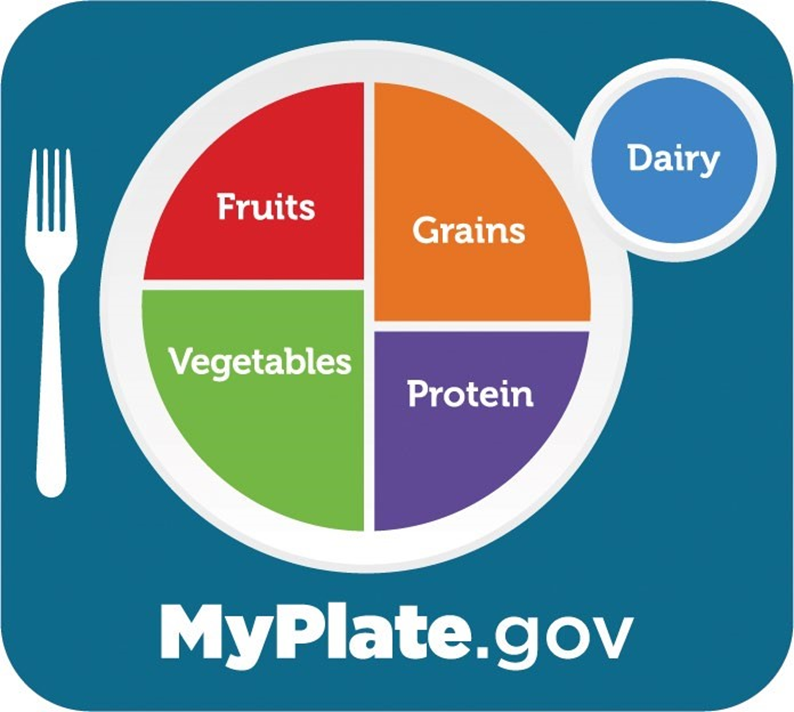
The United States Department of Agriculture
(USDA) developed MyPlate to help people build a healthy plate at mealtimes.
The MyPlate icon emphasizes vegetables, fruits, grains, protein, and low-fat dairy products.
Key Material 8-2: USDA MyPlate
Do you know any other ideas for making healthy food choices?
2. Describe factors that influence food preferences
Why is it important to know and honor residents’ food preferences?
2. Describe factors that influence food preferences
REMEMBER:
Residents have a legal right to make choices about their food and to refuse food. NAs must honor residents’ beliefs and preferences.
2. Describe factors that influence food preferences
Think about your own regional, cultural, or religious food practices.
How would these be affected if you had to move into a long-term care facility?
3. Explain special diets
therapeutic, modified, or special diets
diets for people who have certain illnesses, conditions or food allergies.
puree
to blend or grind food into a thick paste of baby food consistency.
3. Explain special diets
REMEMBER:
Special diets are often ordered for residents who have certain illnesses or conditions.
Sometimes they are ordered to help a resident gain or lose weight. Some diets are ordered for a short time before a medical test or surgery.
3. Explain special diets
What do you think could happen if a resident with a special diet order receives the wrong tray?
How can an NA prevent this from happening?
What are some of the special diets residents may need?
How are they different from a standard diet?
3. Explain special diets
Choose a special diet from pages 222–224 of the textbook. Give a one-minute report to the rest of the class, including a one-day/three meal menu plan. Food choices should be based on the foods allowed and the foods you prefer.
The rest of the class can ask questions about whether specific foods are included in the special diet.
4. Describe how to assist residents in maintaining fluid balance
NPO
Abbreviation meaning nothing by mouth; medical order that means a person should not have anything to eat or drink. dehydration a serious condition that results from inadequate fluid in the body.
4. Describe how to assist residents in maintaining fluid balance
REMEMBER:
Drinking enough water or other fluids each day can help prevent constipation, urinary incontinence, and dehydration.
How do you think nursing assistants can help prevent dehydration?
4. Describe how to assist residents in maintaining fluid balance
REMEMBER:
A resident with an NPO order cannot have any food or drink. An NA should never offer food or drink – not even water – to a resident who is designated NPO.
4. Describe how to assist residents in maintaining fluid balance
Report any of these signs and symptoms of dehydration:
- Being thirsty
- Drinking little or no fluids at meals
- Needing help drinking from cup
- Having trouble swallowing liquids
- Having fatigue and weakness
4. Describe how to assist residents in maintaining fluid balance
Can you think of any other signs and symptoms that may relate to dehydration?
Why do you think a question like
“Would you like water or juice?” may be a better way to help a resident stay hydrated than
“Do you want anything to drink?”
4. Describe how to assist residents in maintaining fluid balance
fluid overload
a condition that occurs when the body cannot handle the amount of fluid consumed.
edema
swelling caused by excess fluid in body tissues.
4. Describe how to assist residents in maintaining fluid balance
True or False?
Fluid overload happens when the body cannot eliminate the fluid consumed.
5. List ways to identify and prevent unintended weight loss
Why must an NA report any weight loss in a resident, no matter how small?
NAs can help prevent unintended weight loss.
What observations about residents may relate to unintended weight loss?
5. List ways to identify and prevent unintended weight loss
NA Sanna cares for Mrs. Crabtree, a long-time resident at Hartman Hills. Several viruses have been spreading among the residents recently and Mrs. Crabtree has caught them. She has lost some weight due to sickness. What can Sanna do to help her prevent further weight loss?
6. Identify ways to promote appetites at mealtime
When you eat with friends or family, do you just eat?
Do you talk? What do you talk about?
What do you do to prepare for a meal?
Do you eat at the same times every day?
Are there routines you follow?
Think about how you can help make dining pleasant for residents.
7. Demonstrate how to assist with eating
When assisting residents with eating NAs should remember the following:
- Residents will need different levels of help.
- Some residents will only need help with setting up but can feed themselves.
- Some residents will need to be fed. Be sensitive and give privacy.
- Encourage residents to do what they can.
7. Demonstrate how to assist with eating
For each of these guidelines for assisting a resident with eating, answer these questions:
- Is this guideline about safety?
- Is this guideline about respecting resident dignity?
- Is there another purpose for this guideline?
7. Demonstrate how to assist with eating
REMEMBER:
An NA should not insist that a resident use a clothing protector and should never refer to a clothing protector as a bib.
8. Identify signs and symptoms of swallowing problems
dysphagia difficulty swallowing.
Any of the following can cause dysphagia:
- Stroke
- Alzheimer’s disease
- Head/neck cancer
- Multiple sclerosis
- Parkinson’s disease
8. Identify signs and symptoms of swallowing problems
Mr. Paulsen just returned to Hartman Hills after being hospitalized with a stroke. The care team has been cautioned to observe him carefully for swallowing problems.
What should NAs watch for while helping Mr.
Paulsen with meals?
8. Identify signs and symptoms of swallowing problems
Mr. Paulsen has an order for thickened liquids. The ordered consistency is nectar thick.
What is the purpose of thickened liquids?
Will NAs have to thicken liquids for Mr. Paulsen?
Can Mr. Paulsen drink regular (un-thickened) water?
8. Identify signs and symptoms of swallowing problems
REMEMBER:
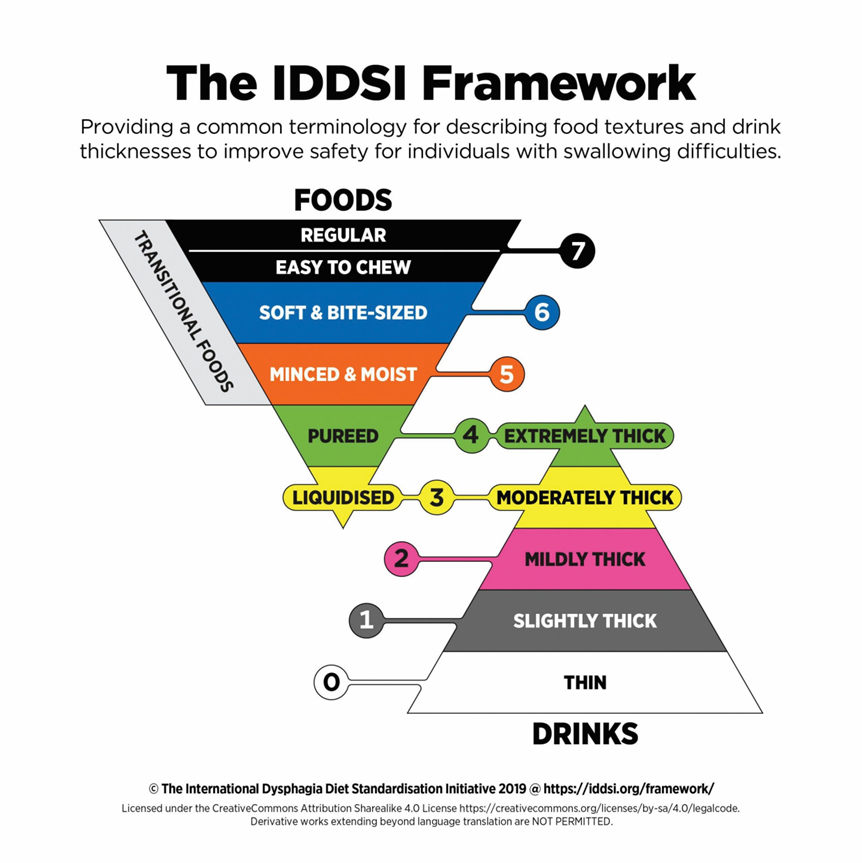
Some facilities may use the International
Dysphagia Diet Standardization Initiative’s (IDDSI) framework to identify food textures and drink thicknesses.
Key Material 8-3: IDDSI Framework
Key Material 8-3: Preventing Aspiration
- Position in a straight, upright position (90degree angle) for eating or drinking.
- Offer small pieces of food or small spoonfuls of pureed food.
- Feed the resident slowly.
- Place food in the unaffected side of the mouth.
- Make sure mouth is empty before offering the next bite of food or sip of drink.
- Have residents remain upright for at least 30 minutes after eating and drinking.
8. Identify signs and symptoms of swallowing problems
parenteral nutrition (PN) the intravenous infusion of nutrients administered directly into the bloodstream, bypassing the digestive system.
nasogastric tube a feeding tube that is inserted into the nose and goes to the stomach.
8. Identify signs and symptoms of swallowing problems
percutaneous endoscopic gastrostomy (PEG) tube a feeding tube placed in the stomach through the abdominal wall.
gastrostomy a surgically created opening into the stomach in order to insert a tube.
8. Identify signs and symptoms of swallowing problems
Use information from this learning objective to finish these sentences:
If a person’s digestive system does not function properly, _______ ________ may be ordered. With this type of feeding, a solution of nutrients goes directly into the ____________.
If a person can digest food but cannot swallow, he may be fed through a ___________ tube or a __________ ___________ ___________ (PEG) tube.
8. Identify signs and symptoms of swallowing problems
REMEMBER:
An NA’s role in tube feedings is observation for problems and changes in the resident. NAs never insert or remove tubes, do the feeding, or clean the tubes.
8. Identify signs and symptoms of swallowing problems
Mrs. DeWaters receives tube feedings. NA Anwen is assigned to help the nurse prepare for a feeding.
What tasks might this involve? What should Anwen be aware of and what should she observe for and report while caring for Mrs. DeWaters?
9. Describe how to assist residents with special needs
REMEMBER:
Residents with certain conditions or diseases, such as stroke, Parkinson’s disease,
Alzheimer’s disease or other dementias, head trauma, blindness or confusion may need additional help when eating.
9. Describe how to assist residents with special needs
NAs should remember these helpful dining techniques for assisting residents with special needs:
- Use assistive devices as ordered.
- Use physical and verbal cues.
- Always put food into the stronger side of the mouth.
- For residents with vision impairment, use imaginary clock face to explain the position of food on a plate.
9. Describe how to assist residents with special needs
Look at the tips found on pages 233–234 of the textbook. Create an imaginary resident and describe to the class how you assist the resident at mealtimes. The class will guess what challenge you are addressing.
Example: After giving Mrs. Bird a bite of food, I watch her chew and then press an empty teaspoon against her lips. [Mrs. Bird holds food in her mouth.]