
1. Discuss rehabilitation and restorative care
rehabilitation care that is given by specialists to help restore or improve function after an illness or injury.
restorative care given after rehabilitation to maintain a person’s function, improve his quality of life and increase his independence.
1. Discuss rehabilitation and restorative care
Use information from this learning objective to finish these sentences:
____________________ is care used to restore a person to her highest level of functioning possible after an accident, illness, or injury.
_____________ _____________ may follow in order to maintain functioning, improve quality of life, and increase independence.
1. Discuss rehabilitation and restorative care
Do you think rehabilitation for these two residents will progress at the same speed? Why or why not?
Mrs. Klima was a college basketball star as a young woman. She went on to coach basketball for many years and stayed very fit. She is in rehabilitation after a stroke left her partially paralyzed.
Mr. Romero was a professional pianist. He was in a car accident and his hands were seriously injured. He is not very interested in rehabilitation because he knows he will not be able to play the piano again.
Key Material 9-1: Assisting with Rehabilitation and Restorative Care
- Be patient.
- Be positive and supportive.
- Focus on small tasks and small accomplishments.
- Recognize that setbacks occur.
- Be sensitive to the resident’s needs.
- Encourage independence.
- Provide privacy.
- Involve residents in their care.
1. Discuss rehabilitation and restorative care
NAs should observe for and report the following signs and symptoms during rehabilitation and restorative care:
- Increase or decrease in abilities
- Change in attitude or motivation
- Change in general health
- Signs of depression or mood changes
1. Discuss rehabilitation and restorative care
How could an NA can adapt their motivational style to fit each of the following residents?
- Mrs. T is a shy, quiet, elderly woman learning to dress herself
- Mr. M is a very proud retired Marine major who must learn to feed himself
- Mrs. G is a grandmother who must learn to use a leg brace to walk
1. Discuss rehabilitation and restorative care
- Mr. J is an athlete who must accept being confined to a wheelchair
- Mrs. C must now wear an incontinence brief for permanent incontinence
- Mr. D has been told he will never walk again as he and his doctors hoped he would
- Mr. H has been trying unsuccessfully for two weeks to learn to use special eating utensils
2. Describe the importance of promoting independence and list ways exercise improves health
Why is it important for you to encourage independence in residents even though it may be easier and faster for you to do a task yourself, and to allow residents to do as much for themselves as is possible?
2. Describe the importance of promoting independence and list ways exercise improves health
Lack of mobility affects every body system. Can you think of some examples of effects on different systems?
What other problems may be caused by immobility?
Key Material 9-2: Regular Ambulation and Exercise
Regular ambulation and exercise help improve the following:
- Quality and health of skin
- Circulation
- Strength
- Sleep and relaxation
- Mood
- Self-esteem
- Appetite
- Elimination
- Blood flow
- Oxygen level
3. Discuss ambulation and describe assistive devices and equipment
ambulation walking.
ambulatory capable of walking.
assistive devices special equipment that helps a person who is ill or disabled to perform activities of daily living.
3. Discuss ambulation and describe assistive devices and equipment
REMEMBER: NAs should always check the care plan before helping a resident to ambulate and must keep the resident’s limitations in mind.
3. Discuss ambulation and describe assistive devices and equipment
When would a resident use a cane?
A walker?
Crutches?
Have you ever tried to use any of these devices?
3. Discuss ambulation and describe assistive devices and equipment
REMEMBER:
Residents using new aids to ambulation will likely be off-balance. NAs should stay close by and observe residents for signs of dizziness.
4. Explain guidelines for maintaining proper body alignment
True or False?
Proper body alignment is not important when residents are confined to bed.
Key Material 9-3 Proper Body Alignment:
Key Material 9-3 Proper Body Alignment:
- Observe principles of alignment.
- Keep body parts in natural positions.
- Prevent external rotation of hips.
- Change positions often, at least every two hours.
- Give back rubs as ordered.
5. Describe care guidelines for prosthetic devices
amputation the surgical removal of some or all of a body part, usually a hand, arm, leg, or foot. phantom sensation warmth, itching, or tingling in a body part that has been amputated.
phantom limb pain pain in a limb (or extremity) that has been amputated.
prosthesis a device that replaces a body part that is missing or deformed because of an accident, injury, illness, or birth defect; used to improve a person’s ability to function and/or to improve appearance.
5. Describe care guidelines for prosthetic devices
Mr. Campbell had a foot amputated due to complications of diabetes. He was recently fitted with a prosthesis.
How will NA Carolyn assist him with the prosthesis? What other help can she give Mr. Campbell?
5. Describe care guidelines for prosthetic devices
True or False?
An artificial eye is a type of prosthesis.
6. Describe how to assist with range of motion exercises
range of motion (ROM)
exercises that put a joint through its full arc of motion.
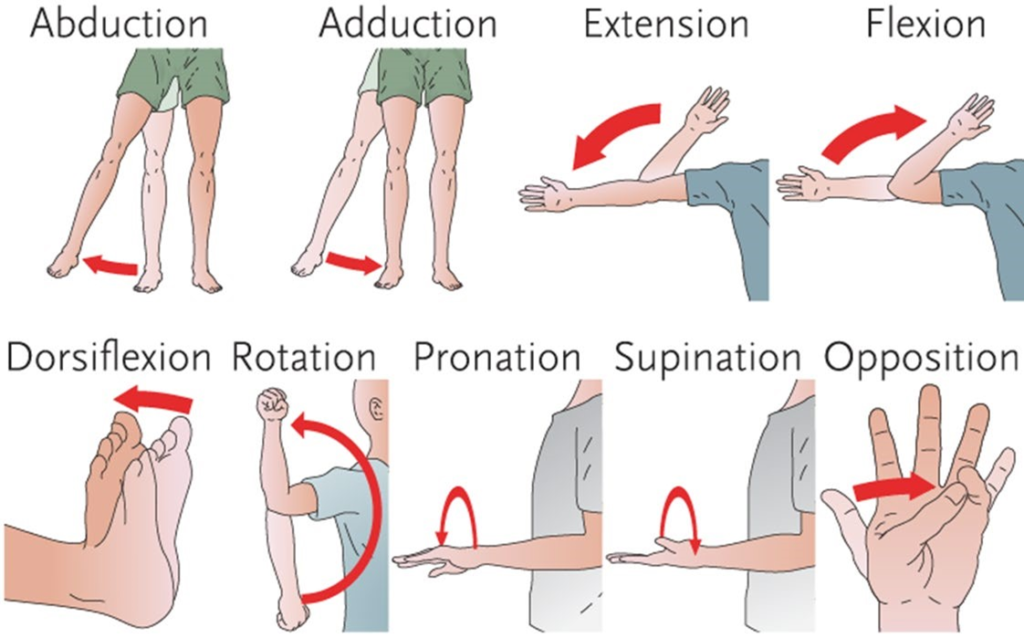
abduction moving a body part away from the midline of the body.
adduction moving a body part toward the midline of the body.
extension straightening a body part.
flexion bending a body part. dorsiflexion bending backward.
rotation turning a joint. pronation turning downward.
supination turning upward.
opposition touching the thumb to any other finger.
6. Describe how to assist with range of motion exercises
Use information from this learning objective to finish these sentences:
____________________ exercises put a joint through its full arc of motion.
____________________ are done by a resident alone, without help.
____________________ are done by a resident with some help from a staff member. ____________________ are done by a staff member, without the resident’s help.
Key Material 9-4: Body Movements
7. List guidelines for assisting with bladder and bowel retraining
When might a resident need help reestablishing a regular routine and normal bowel or bladder function?
REMEMBER:
Keeping a positive attitude when residents are going through bowel or bladder retraining can make a huge difference.
7. List guidelines for assisting with bladder and bowel retraining
How would it feel if you were unable to control elimination?
Why is it important to use proper terms for bodily functions and not treat residents like children?
7. List guidelines for assisting with bladder and bowel retraining
REMEMBER:
Cleaning up right after a resident has an episode of incontinence protects dignity and prevents damage to the skin.