
1.Identify basic human needs
Define the following term:
physiological needs
needs that relate to the processes and activities that keep living things alive.
psychosocial needs
needs that involve social interaction, emotions, intellect, and spirituality.
1.Identify basic human needs
These are the basic physical needs of human beings:
•Food and water
•Protection and shelter
•Activity
•Sleep and rest
•Comfort, freedom from pain
1.Identify basic human needs
Some nursing assistant tasks address residents’ physical needs, including the following:
•Assisting with eating
•Assisting with elimination
•Assisting with bathing
•Assisting with grooming
1.Identify basic human needs
These are six psychosocial needs of human beings:
•Love and affection
•Acceptance by others
•Safety and security
•Self-reliance and independence in daily living
•Contact with others
•Success and self-esteem
1.Identify basic human needs
When a person’s psychosocial needs are not met the response may include
•Frustration
•Stress
•Fear
•Withdrawal
•Depression
•Anxiety
•Anger
•Aggression
1.Identify basic human needs
Think about this question:
How could the strong negative feelings associated with unmet psychosocial needs interfere with residents’ health?
Key Material 3-1: Maslow’s Hierarchy of Needs

1.Identify basic human needs
Think about these questions:
What do self-esteem and self-actualization mean to you?
Which of the needs in Maslow’s Hierarchy of Needs are physiological? Which are psychosocial?
Are any of the needs more important than the others?
1.Identify basic human needs
Define the following term:
masturbation
to touch or rub sexual organs in order to give oneself or another person sexual pleasure.
1.Identify basic human needs
REMEMBER:
Respect and privacy are very important when encountering any sexual situation.
1.Identify basic human needs
It is important for NAs to remember the following about residents’ sexual needs and sexual situations:
•People continue to have sexual needs throughout their lives.
•Humans express their sexuality through different behaviors.
•Knock and wait for a response before entering residents’ rooms.
•Provide privacy if you encounter a sexual situation.
•Be open and nonjudgmental.
•Respect residents’ sexual orientation and gender identity.
•Use the pronouns and names that transgender residents wish to use.
1.Identify basic human needs
It is important for NAs to remember the following about residents’ sexual needs and sexual situations (cont’d):
•Honor Do Not Disturb signs.
•Do not view expressions of sexuality by elderly as cute or disgusting.
Handout 3-1: Myths About Older Adults and Sexuality
•Myth #1: Older men are not capable of having sexual relations. There are some physical changes that may alter the way a couple engages in sexual relations. Men may need more direct contact, may take longer, and may need longer between sexual activities to perform again. However, many men continue to have satisfying relations well into old age.
•Myth #2: After menopause women are not interested in sexual relations. Many women relax and enjoy sex more in later years. With no fear of pregnancy, many women feel much freer. There may be some physical changes, such as less lubrication, but there are remedies available. Communication with their physicians is important. The reason many older women stop having sex is because they lose their partners when their partners die.
Handout 3-1: Myths About Older Adults and Sexuality (cont’d)
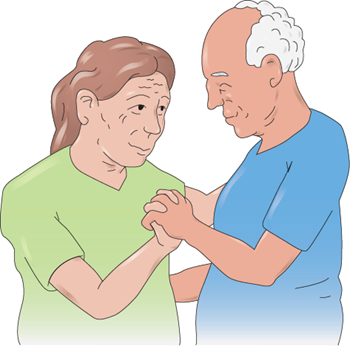
•Myth #3: Any expression of sexuality by older people is either disgusting or cute. This attitude deprives older people of their right to dignity and respect. Older adults have the same needs and rights to express their sexuality as other age groups, and they may do so in the same ways. In all age groups there is a wide variety of behavior. This is also true of older people.
It is true, however, that our society discourages this expression by the messages sent through jokes, advertisements, and the media. Older people see and hear these messages and may believe that there is something wrong with them if they feel or act on their desires.
1.Identify basic human needs
REMEMBER:
Residents must be protected from unwanted sexual advances. If an NA sees sexual abuse happening, he should remove the resident from the situation and take the resident to a safe place. He should then report to the nurse immediately.
1.Identify basic human needs
NAs can help residents meet their spiritual needs in these ways:
•Learn about their religions or beliefs.
•Respect residents’ decisions to participate in, or refrain from, food-related rituals.
•Encourage participation in religious services for residents who are religious.
•Respect all religious items.
•Report requests to see clergy to nurse.
•Allow privacy for clergy visits.
•If asked, read religious materials aloud.
•Refer resident to spiritual resources if requested.
Key Material 3-2: Not Permitted
Nursing assistants should never do the following:
•Try to change someone’s religion
•Tell a resident their belief or religion is wrong
•Express judgments about a religious group
•Insist that residents join religious activities
•Interfere with religious practices
•Discuss their personal beliefs or opinion either directly or indirectly
1.Identify basic human needs
Think about these questions:
Why should you not be judgmental about other people’s beliefs?
Why should you not impose your beliefs on your residents?
Would your political ideas be appropriate topics of conversation with your resident or his family?
What are some appropriate topics of conversation with residents and their families?
2.Define holistic care
Define the following term:
holistic care
a type of care that involves caring for the whole person—the mind as well as the body.
2.Define holistic care
Think about this question:
Can you think of an example of how NAs can provide holistic care to residents?
3.Explain why promoting independence and self-care is important
Residents in LTC facilities may be experiencing any of these losses:
•Loss of spouse, family, or friends
•Loss of workplace and its relationships
•Loss of ability to go places
•Loss of ability to attend services and meetings at their faith communities
•Loss of home and personal possessions
•Loss of health and ability to care for themselves
•Loss of ability to move freely
3.Explain why promoting independence and self-care is important
Residents in LTC facilities may be experiencing any of these losses (cont’d):
•Loss of pets
•LGBTQ residents may fear the loss of a comfortable or accepting environment
3.Explain why promoting independence and self-care is important
Loss of independence can cause:
•Poor self-image
•Anger
•Feelings of helplessness, sadness, and hopelessness
•Feelings of uselessness
•Increased dependence
•Depression
3.Explain why promoting independence and self-care is important
NAs promote independence in residents when they do the following:
•Encourage residents to do as much as possible for themselves, no matter how long it takes.
•Be patient.
•Allow residents to make choices.
3.Explain why promoting independence and self-care is important
REMEMBER:
It is important that NAs never treat residents like children. Residents are adults who can make their own choices and should care for themselves as independently as possible.
4.Identify ways to accommodate cultural differences
Define the following term:
cultural diversity
the different groups of people with varied backgrounds and experiences who live together in the world.
bias
prejudice
race
grouping of people based on physical characteristics shared by people with common ancestry.
ethnicity
one aspect of a person’s identity, often reflecting a combination of race, culture, language, nationality, and other factors.
4.Identify ways to accommodate cultural differences
Culture plays a part in determining all of the following:
•Language
•Religion
•Food preferences
•Touch
Handout 3-2: Religions and Dietary Practices
Understanding a little bit about common religious groups may be useful. Common religions, listed alphabetically, follow:
Buddhism: Buddhism started in Asia but has many followers in other parts of the world. Buddhism is based on the teachings of Siddhartha Gautama, called Buddha. Buddhists believe that life is filled with suffering that is caused by desire and that suffering ends when desire ends. Buddhism emphasizes meditation. Proper conduct and wisdom release a person from desire, suffering, and a repeating sequence of births and deaths (reincarnation). Nirvana is the highest spiritual plane a person can reach. It is the state of peace and freedom from worry and pain. There are many Buddhist texts. The Tipitaka or Pali Canon is the standard scripture collection. The Dalai Lama is considered to be the highest spiritual leader.
Handout 3-2: Religions and Dietary Practices (cont’d)
Christianity: Christians believe Jesus Christ was the son of God and that he died so their sins would be forgiven. Christians may be Catholic or Protestant. There are many subgroups or denominations (such as Baptist, Episcopalian, Evangelical, Lutheran, Methodist, Mormon, Presbyterian, and Roman Catholic). Christians may be baptized and may receive communion as a symbol of Christ’s sacrifice. They may attend church on Saturdays or Sundays. Some Christians may try to share their beliefs and convert others to their faith. The Christian Bible is the sacred text and is divided in to the Old Testament and the New Testament. Religious leaders may be called priests, ministers, pastors, preachers, or reverends.
Handout 3-2: Religions and Dietary Practices (cont’d)
Hinduism: Hinduism is the dominant faith of India, but it is practiced in other places as well. According to Hindu beliefs, there are four purposes of life: acting morally and ethically (Dharma), pursuing prosperity (Artha), enjoying life (Karma), and accomplishing enlightenment (Moksha). People move through birth, life, death and rebirth. How a person moves toward enlightenment is determined by karma. Karma is the result of actions in past lives and actions in this life can determine one’s destiny in future lives. Hindus advocate respect for all life, and some Hindus are vegetarians. Hindus who do eat meat almost always refrain from eating beef. Hindus follow the teachings of ancient scriptures like the Vedas and Upanishads, as well as other major scriptures. Holy men are called Sadhus.
Handout 3-2: Religions and Dietary Practices (cont’d)
Islam: Muslims, or followers of Mohammed, believe that Allah (the Arabic term for God) wants people to follow the teachings of the prophet Mohammed. Many Muslims pray five times a day facing Mecca, the holy city for their religion. Muslims also fast during a month-long observation called Ramadan. Muslims worship at mosques and do not drink alcohol or eat pork. There are other dietary restrictions, too. The Qur’an (Koran) is the sacred text of Islam. Islamic religious leaders may be called ayatollah, caliph, imam, mufti, or mullah, among other titles.
Handout 3-2: Religions and Dietary Practices (cont’d)
Judaism: Judaism is divided into Reform, Conservative, and Orthodox movements. Jewish people believe that God gave them laws through Moses in in the form of the Torah (the sacred text), and that these laws should order their lives. Jewish services are held in synagogues or temples on Friday evenings and sometimes on Saturdays. Some Jewish men wear a yarmulke, or small skullcap, as a sign of their faith. Some Jewish people observe dietary restrictions. They may not do certain things, such as work or drive, on the Sabbath day (called Shabbat), which lasts from Friday sundown to Saturday sundown. Religious leaders are called rabbis.
Handout 3-2: Religions and Dietary Practices (cont’d)
Spirituality concerns a person’s beliefs about the spirit or the soul. It may center on how a person relates to his community, to nature, or to the divine. It may involve reflection and contemplation and a search for inner peace. It may elate to a person’s beliefs about the meaning of life. Spiritual practices can include meditation or prayer, but spirituality does not have to encompass religious beliefs. Many people consider themselves to be spiritual but not religious.
Many Native Americans (American Indians) follow many different spiritual traditions and practices. An emphasis is placed on the personal and the communal, rather than the institutional, and there is a deep connection with nature. There are many varied practices and rituals.
Handout 3-2: Religions and Dietary Practices (cont’d)
Some people may not believe in God or a higher power and identify themselves as agnostic. Agnostics claim that they do not know or cannot know if God exists. They do not deny that God might exist, but they feel there is no true knowledge of God’s existence. Atheists are people who believe that there is no God. This is different from what agnostics believe. Atheists actively deny the existence of any deity (higher power). For many atheists, this belief is as strongly held as any religious belief.
Handout 3-2: Religions and Dietary Practices (cont’d)
Some specific cultural and religious practices affect a nursing assistant’s work. Many religious beliefs include dietary restrictions. These are rules about what and when followers can eat. Some examples are listed below.
•Many Buddhists are vegetarians, though some include fish in their diet.
•Some Christians, particularly Roman Catholics, do not eat meat on Fridays during Lent.
•Many Jewish people eat kosher foods, do not eat pork, and do not eat lobster, shrimp, and clams (shellfish). Kosher food is food prepared in accordance with Jewish dietary laws. Kosher and non-kosher foods cannot come into contact with the same plates. Jewish people who observe dietary laws may not eat meat products at the same meal with dairy products.
•Mormons may not drink alcohol, coffee, or tea. They may not use tobacco in any form.
Handout 3-2: Religions and Dietary Practices (cont’d)
•Muslims do not eat pork and may avoid certain birds. They may not drink alcohol. Muslims may have regular periods of fasting. Fasting means not eating food or eating very little food.
•Some people are vegetarians and do not eat any meat for religious, moral, or health reasons.
•Some people are vegans and do not eat any animals or animal products, such as eggs or dairy products. Vegans may also not use or wear any animal products, including leather.
4.Identify ways to accommodate cultural differences
In small groups, ask each other these questions:
•Where did you grow up? Did you like it?
•What kinds of food were served at your house?
•What languages do you know?
4.Identify ways to accommodate cultural differences
Think about this question:
How can knowing about the residents she cares for help an NA do a better job meeting their needs?
4.Identify ways to accommodate cultural differences
REMEMBER:
NAs should focus on compassionate, respectful, and culturally-sensitive care. They should treat residents as the residents wish to be treated, not as the NA would want to be treated. This is part of person-centered care.
5.Describe the need for activity
Physical activity has the following positive effects:
•Lessens risk of illnesses
•Relieves symptoms of depression
•Improves mood and concentration
•Improves body function
•Lowers risk of falls
•Improves sleep
•Improves ability to cope with stress
•Increases energy
•Increases appetite
5.Describe the need for activity
Inactivity can cause the following problems:
•Loss of self-esteem
•Anxiety
•Depression
•Boredom
•Pneumonia
•Urinary tract infection
•Skin breakdown and pressure ulcers
•Constipation
•Blood clots
•Dulling of senses
6.Discuss family roles and their significance in health care
There are many different family types, including the following:
•Nuclear families
•Single-parent families
•Married or committed couples of the same sex or opposite sex
•Extended families
•Blended families
6.Discuss family roles and their significance in health care
A chosen family is a term that has roots in the LGBTQ community and refers to very close, supportive relationships some people have with others who are not their biological relatives.
6.Discuss family roles and their significance in health care
●
Families may participate in the care of residents in these ways:
•Helping to make care decisions
•Communicating with care team
•Giving support and encouragement
•Connecting to outside world
•Giving assurance to dying residents
6.Discuss family roles and their significance in health care
●
REMEMBER:
Residents’ families are likely experiencing significant adjustments. NAs should be respectful. They should allow privacy for visits and observe and report the effect of visits on residents.
6.Discuss family roles and their significance in health care
●
REMEMBER:
NAs should take the time to ask families questions. NAs should communicate with families and show them that NAs have time for them.
7.Describe the stages of human growth and development
●
Define the following term:
cognitive
related to thinking and learning.
7.Describe the stages of human growth and development
●
Infancy (Birth to 12 months)
•Grow and develop quickly
•Development is from head down
7.Describe the stages of human growth and development
●
Toddlerhood (Ages 1 to 3)
•Formerly dependent, now gaining independence and body control
•Learn to speak, gain coordination, and bladder and bowel control
•May have tantrums or whine to get their way
7.Describe the stages of human growth and development
●
Preschool Years (ages 3 to 5)
•More social relationships
•Play cooperatively and learn language
•Learn right from wrong
7.Describe the stages of human growth and development
School-Age years (Ages 5 to 10)
•Cognitive development (thinking and learning)
•Learn to get along with others in their peer group
•Develop a conscience and self-esteem
7.Describe the stages of human growth and development
●
Preadolescence (Ages 10 to 12)
•Growing sense of identity
•Strongly identify with peers
•Relatively calm period
•Imaginary fears give way to fears based in real world
7.Describe the stages of human growth and development
●
Adolescence (Ages 12 to 18)
•Onset of puberty
•Secondary sex characteristics
•Reproductive organs begin to function
•Concern for body image and peer acceptance
•Changing moods
7.Describe the stages of human growth and development
●
Young Adulthood (ages 18 to 40), people often
•Select an education
•Select a career
•Select and live with a mate
•Raise children
•Develop a satisfying sex life
7.Describe the stages of human growth and development
●
Middle Adulthood (Ages 40 to 65)
•More comfortable and stable
•Physical changes related to aging occur
7.Describe the stages of human growth and development
●
Late adulthood (65 years and older)
•Many physical and psychosocial changes
•Loss of physical health
•Loss of friends and jobs
•Lose friends
7.Describe the stages of human growth and development
●
Define the following term:
ageism
prejudice toward, stereotyping of, and/or discrimination against older persons or the elderly.
Key Material 3-3: True or False
1.People over 80 years old cannot live by themselves.
2.Most older adults are lonely and depressed.
3.Older adults are not able to adjust to changes.
4.Most older adults are ill or disabled in some way.
5.Older adults can stay active by pursuing favorite hobbies.
6.Good health can help older adults live independently.
7.Normal changes of aging do not include diseases, disabilities, or dependence on others.
7.Describe the stages of human growth and development
●
Remember these facts about aging:
•Older adults have many different capabilities.
•Stereotypes are false.
•Older persons are usually active.
•Aging is a normal process, not a disease.
•Aging persons need to adjust to change.
•They do not need to be dependent.
7.Describe the stages of human growth and development
●
Normal changes of aging include the following:
•Thinner, drier, more fragile, and less elastic skin
•Weaker, less toned muscles
•Less dense, more brittle bones
•Less sensitive nerve endings in skin
•Slower responses and reflexes
•Short-term memory loss
•Weaker senses
7.Describe the stages of human growth and development
●
Normal changes of aging (cont’d):
•Less efficient heart
•Less oxygen in the blood
•Decreased appetite
•More frequent urinary elimination
•Less efficient, slower digestion
•Decreased hormone levels
•Weakened immunity
•Lifestyle changes
7.Describe the stages of human growth and development
●
Remember that the following are not considered normal changes of aging:
•Depression
•Suicidal thoughts
•Unable to think logically
•Poor nutrition
•Shortness of breath
•Incontinence
8.Discuss developmental disabilities
●
Define the following term:
developmental disabilities
disabilities that are present at birth or emerge during childhood that restrict physical and/or mental ability.
8.Discuss developmental disabilities
●
The following are important points about intellectual disabilities:
•Not a disease or psychiatric illness
•Below-average mental functioning
•May have limited ability to live independently
•Have the same emotional and physical needs as others
8.Discuss developmental disabilities
●
NAs should remember the following when caring for residents with an intellectual disability, including meeting emotional and physical needs:
•Treat adult residents as adults.
•Praise and encourage often.
•Help teach ADLs by dividing a task into smaller units.
•Promote independence.
•Encourage social interaction.
•Repeat words you use to make sure they understand.
•Be patient.
9.Describe some types of mental health disorders
Define the following terms:
depression
type of mood disorder that causes pain, fatigue, apathy, sadness, irritability, anxiety, sleeplessness, and loss of appetite as well as other symptoms; also called major depressive disorder or clinical depression.
apathy
a lack of interest in activities
bipolar disorder
a mental health disorder that causes a person to swing from periods of deep depression (a depressive episode) to periods of extreme activity (a manic episode).
9.Describe some types of mental health disorders
Define the following terms:
anxiety
Uneasiness, worry, or fear, often about a situation or condition.
generalized anxiety disorder (GAD)
an anxiety disorder that is characterized by anxiety and worry, even when there is no cause for those feelings.
panic disorder
a disorder characterized by a person having regular panic attacks or living with constant anxiety about having another attack.
social anxiety disorder
a disorder in which a person has excessive anxiety about social situations.
9.Describe some types of mental health disorders
Define the following terms:
phobia
an intense irrational fear of or anxiety about an object, place, or situation.
obsessive-compulsive disorder (OCD)
an anxiety disorder characterized by obsessive behavior or thoughts which may cause the person to repeatedly perform a behavior or routine.
posttraumatic stress disorder (PTSD)
an anxiety disorder caused by experiencing or witnessing a traumatic experience.
9.Describe some types of mental health disorders
Define the following terms:
schizophrenia
a type of psychotic disorder that causes problems with thinking, communication, and the ability to manage emotions, make decisions, and understand reality.
hallucinations
false or distorted sensory perceptions.
9.Describe some types of mental health disorders
Define the following terms:
delusions
persistent false beliefs.
psychotherapy
a method of treating mental health disorders that involves talking about one’s problems with mental health professionals.
cognitive behavior therapy (CBT)
a type of psychotherapy that is often used to treat anxiety disorders and depression and focuses on skills and solutions that a person can use to modify negative thinking and behavior patterns.
9.Describe some types of mental health disorders
NAs should remember the following when caring for residents who have a mental health disorder:
•Observe residents for changes. Document and report.
•Support the resident and his family and friends.
•Encourage residents to do as much for themselves as possible.
•Remember that mental health disorders can be treated.
9.Describe some types of mental health disorders
When caring for residents with mental illness it is important to observe for and report the following:
•Changes in ability
•Positive or negative mood changes (withdrawal)
•Behavior changes
•Comments about hurting self or others (including jokes)
•Failure to take medicine
•Real or imagined physical symptoms
•Events, situations, or people that provoke certain reactions
9.Describe some types of mental health disorders
REMEMBER:
Intellectual disability and mental health disorders are not the same. Although they are different conditions, persons who have either condition need emotional support, as well as care and treatment.
10.Explain how to care for residents who are dying
Define the following terms:
terminal illness
a disease or condition that will eventually cause death.
grief
deep distress or sorrow over a loss.
10.Explain how to care for residents who are dying
In her book On Death and Dying Dr. Elisabeth Kübler-Ross describes five stages of dying:
•Denial: refusal to believe they are dying
•Anger: “Why me?”
•Bargaining: “Yes me, but . . .”
•Depression: the need to mourn and review their lives
•Acceptance: preparing for death
10.Explain how to care for residents who are dying
REMEMBER:
Not every dying person goes through all of these stages or goes through them in this order.
10.Explain how to care for residents who are dying
Define the following terms:
advance directives
Legal documents that allow people to choose what medical care they wish to have if they are unable to make those decisions themselves.
living will
a document that outlines the medical care a person wants, or does not want, in case she becomes unable to make those decisions.
10.Explain how to care for residents who are dying
Define the following terms:
durable power of attorney for health care
a signed, dated, and witnessed legal document that appoints someone else to make the medical decisions for a person in the event she becomes unable to do so.
do-not-resuscitate (DNR) order
a medical order that instructs medical professionals not to perform cardiopulmonary resuscitation (CPR) in the event or cardiac or respiratory arrest.
10.Explain how to care for residents who are dying
When an advance directive is in place
•NAs may be asked to continue to monitor vital signs and report readings to the nurse
•Comfort measures, such as pain medication, will continue to be used
•Depending on the details of the advance directive, CPR and extraordinary measures may be prohibited
10.Explain how to care for residents who are dying
REMEMBER:
Advance directives must be honored, no matter the care team’s personal feelings about the situation.
10.Explain how to care for residents who are dying
All of these factors can influence feelings and attitudes about death:
•Experience with death
•Personality type
•Religious beliefs
•Cultural background
10.Explain how to care for residents who are dying
Think about these questions:
How does your background affect your feelings about death?
Have you experienced the death of someone close to you?
10.Explain how to care for residents who are dying
When caring for the dying resident NAs should be aware of these concerns:
•Diminished senses – lighting should be kept low; hearing is usually the last sense to leave the body
•Care of mouth and nose – mouth care should be provided every two hours
•Skin care – skin should be kept clean and dry, and sheets wrinkle-free
•Comfort – pain relief is critical; NAs should observe carefully for signs of pain
•Environment – the dying resident should be made comfortable, even if he is unaware of his surroundings
•Emotional and spiritual support – dying residents may
need someone to listen more than anything else
10.Explain how to care for residents who are dying
Think about these questions:
How can you treat residents with dignity when they are approaching death?
Which of the Residents’ Rights may apply when a resident is close to death?
Key Material 3-4: Rights to Remember When Caring for the Terminally Ill
•The right to refuse treatment
•The right to have visitors of their own choosing
•The right to privacy
Handout 3-3: The Dying Person’s Bill of Rights
I have the right to:
•be treated as a living human being until I die.
•maintain a sense of hopefulness, however changing its focus may be.
•be cared for by those who can maintain a sense of hopefulness, however changing this may be.
•express my feelings and emotions about my approaching death in my own way.
•participate in decisions concerning my care.
•expect continuing medical and nursing attentions even though “cure” goals must be changed to “comfort” goals.
•not die alone.
•be free from pain.
•have my questions answered honestly.
•not be deceived.
Handout 3-3: The Dying Person’s Bill of Rights (cont’d)
I have the right to:
•have help from and for my family in accepting my death.
•die in peace and dignity.
•retain my individuality and not be judged for my decisions which may be contrary to beliefs of others.
•discuss and enlarge my religious and/or spiritual experiences, whatever these may mean to others.
•expect that the sanctity of the human body will be respected after death.
•be cared for by caring, sensitive, knowledgeable people who will attempt to understand my needs and will be able to gain some satisfaction in helping me face my death.
• (This was created at a workshop on “The Terminally Ill Patient and the Helping Person,” sponsored by Southwestern Michigan In-service Education Council, and appeared in the American Journal of Nursing, Vol. 75, January, 1975, p. 99.)
Key Material 3-5: Ways to treat Dying People and their Families with Dignity
•Respect their wishes in all possible ways.
•Do not isolate or avoid a resident who is dying.
•Do not make promises that cannot or should not be kept.
•Continue to involve the dying person in facility activities.
•Listen if a resident wants to talk.
•Do not babble or act especially cheerful or sad.
•Keep the resident comfortable.
•Assure privacy when it is desired.
•Respect the privacy of the family and other visitors.
•Help with the family’s physical comfort.
10.Explain how to care for residents who are dying
Define the following term:
Cheyne-Stokes
alternating periods of slow, irregular breathing and rapid, shallow breathing, along with periods of not breathing.
10.Explain how to care for residents who are dying
The following are signs of approaching death:
•Blurred and failing vision
•Unfocused eyes
•Impaired speech
•Diminished sense of touch
•Loss of movement, muscle tone, and feeling
•Rising body temperature or below normal temperature
•Decreasing blood pressure
•Weak pulse that is abnormally slow or rapid
10.Explain how to care for residents who are dying
Signs of approaching death (cont’d):
•Slow, irregular respirations or rapid, shallow respirations (Cheyne-Stokes)
•Rattling or gurgling sound when breathing
•Cold, pale skin
•Mottling, spotting, or blotching of skin caused by poor circulation
•Perspiration
•Incontinence
•Disorientation or confusion
10.Explain how to care for residents who are dying
Define the following term:
postmortem care
care of the body after death.
10.Explain how to care for residents who are dying
NAs should remember these postmortem care guidelines:
•Rigor mortis may make the body difficult to move. Talk to the nurse if you need assistance.
•Bathe the body gently. Place drainage pads where needed.
•Do not remove tubes or other equipment.
•Put in dentures if instructed by the nurse.
•Close the eyes.
10.Explain how to care for residents who are dying
Postmortem care guidelines (cont’d):
•Position the body. Put a small pillow under head.
•Follow facility policy on personal items.
•Strip the bed after body is gone.
•Open windows to air the room. Straighten room.
•Document procedure.
10.Explain how to care for residents who are dying
REMEMBER:
Facilities may have special policies on postmortem care. NAs must know and follow their facilities’ policies.
10.Explain how to care for residents who are dying
Think about these questions:
How can you show emotional support to a resident who is dying? To families after the death?
Do you think it would be difficult for you to provide postmortem care?
10.Explain how to care for residents who are dying
These are common reactions to the death of a loved one:
•Shock: especially at one’s own feelings
•Denial: usually lasts a short time
•Anger: at themselves, God, the doctors, even at the person who died
•Guilt: wishing they had done more, guilty because they are still living
10.Explain how to care for residents who are dying
Common reactions to the death of a loved one (cont’d):
•Regret: for what they did or did not do
•Relief: relief that their loved one is no longer suffering, relief that they (family members) no longer have a responsibility (emotional, physical, financial) regarding care
•Sadness: depression, headaches, or insomnia
•Loneliness: missing the person and having painful memories
11.Define the goals of a hospice program
Define the following terms:
hospice care
holistic, compassionate care given to people who have approximately six months or less to live.
palliative care
Care given to people who have serious diseases or who are dying that emphasizes relieving pain, controlling symptoms, and preventing side effects.
11.Define the goals of a hospice program
Hospice care works to promote
•Comfort of resident
•Dignity of resident
11.Define the goals of a hospice program
REMEMBER:
Hospice care works to meet the physical, emotional, social, and spiritual needs of the resident.
11.Define the goals of a hospice program
Think about this question:
Why is the focus of hospice not on wellness or recovery?
11.Define the goals of a hospice program
It is useful for NAs to have the following skills and attitudes in hospice work:
•Be a good listener.
•Respect privacy and independence.
•Be sensitive to individual needs.
•Be aware of your own feelings.
•Recognize the stress.
•Take good care of yourself.
•Take a break when you need to.
•Allow yourself to grieve
11.Define the goals of a hospice program
Think about these questions:
Are the skills and attitudes necessary for hospice work any different from those required when caring for other residents?
How can NAs deal with their own feelings when doing hospice work?