
1. Explain personal care of residents
hygiene practices to keep bodies clean and healthy. grooming
practices to care for oneself, such as caring for fingernails and hair.
1. Explain personal care of residents
How do you get ready in the morning?
1. Explain personal care of residents
NAs help residents with these same tasks in the morning.
1. Explain personal care of residents
What tasks do you think NAs help residents do in the afternoon and evening?
1. Explain personal care of residents
Would you want somebody to help you brush your teeth or get dressed?
How would it make you feel to need help with these tasks?
Key Material 6-1: Assisting with Personal Care
- Help the resident be as independent as possible.
- Be aware of resident preferences/routines
- Always explain what you will be doing.
- Always provide privacy.
- Observe the resident during care.
Key Material 6-1: Assisting with Personal Care (cont’d)
- Note and report signs and symptoms.
- Observe the resident’s mental state.
- Report any changes.
- Leave the resident’s room clean and tidy.
- Leave the call light within the resident’s reach.
1. Explain personal care of residents
How else can NAs help promote privacy, respect, and dignity during personal care?
Why do you think that performing the task is only half the job?
What else do you think can be accomplished while providing personal care?
2. Identify guidelines for providing skin care and preventing pressure injuries
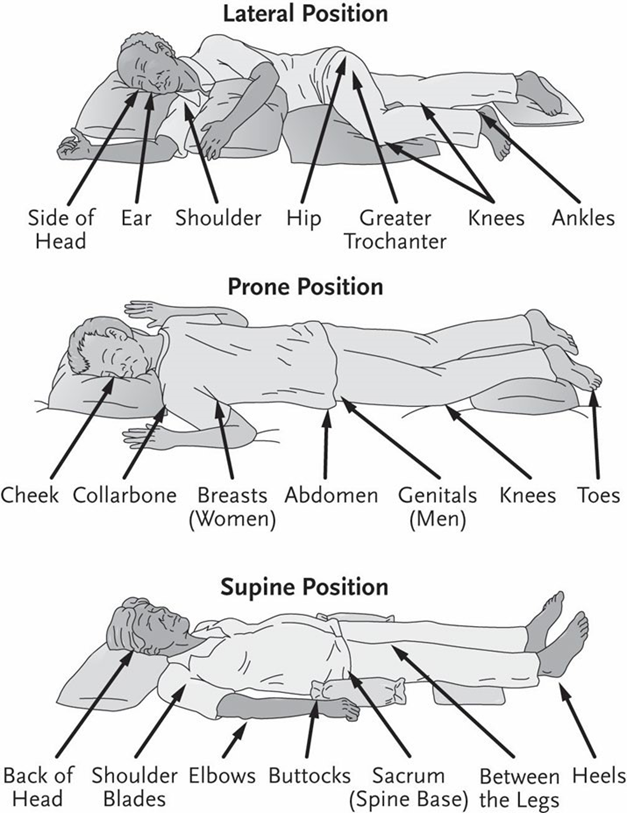
pressure points areas of the body that bear much of the body weight.
bony prominences areas of the body where the bone lies close to the skin.
2. Identify guidelines for providing skin care and preventing pressure injuries
pressure injuries a serious wound resulting from skin deterioration and shearing; also called
pressure ulcers, pressure sores, bed sores,
or decubitus ulcers. shearing rubbing or friction that results from the skin moving one way and the bone
2. Identify guidelines for providing skin care and preventing pressure injuries
underneath it remaining fixed or moving in the opposite direction.
draw sheet an extra sheet placed on top of the bottom sheet; used for moving residents in bed. foot drop
A weakness of muscles in the feet and ankles that causes problems with the ability to flex the ankles and walk normally.
2. Identify guidelines for providing skin care and preventing pressure injuries
orthotic device, or orthosis a device that helps support and align a limb and improve its functioning.
2. Identify guidelines for providing skin care and preventing pressure injuries
REMEMBER:
Prevention is the key to skin health. Once a pressure injury forms, it can get bigger and
deeper and become infected. Pressure injuries are painful and difficult to heal.
-2: Pressure Injury Danger Zones
Key Material 6
2. Identify guidelines for providing skin care and preventing pressure injuries
Why should every resident’s skin be inspected each time that care is provided?
-3: Observing the Skin
- Pale, white, reddened, gray, or purple skin
- Blisters, bruises, or wounds on the skin
Key Material 6
- Differences in temperature of the skin compared to the area around it
- Complaints of tingling, warmth, or burning
- Dry, cracked, or flaking skin
- Itching
Key Material 6
-3: Observing the Skin (cont’d)
- Rash or any skin discoloration
- Swelling
- Fluid or blood draining from the skin
- Broken skin anywhere on the body, including between the toes or around the toenails
Key Material 6
- Changes in existing injury, including size, depth, drainage, color, or odor
-3: Observing the Skin (cont’d)
Darker skin may not look red but may appear
- A different color than surrounding area
- Swollen, painful, firm, or soft
- Warmer or cooler when compared to area around it
2. Identify guidelines for providing skin care and preventing pressure injuries
Key Material 6
Can you think of any other ways NAs can help prevent pressure injuries?
2. Identify guidelines for providing skin care and preventing pressure injuries
Bedbound residents are at a high risk for pressure injuries.
NAs can help prevent them.
How?
3. Describe guidelines for assisting with bathing
partial bath a bath given on days when a complete bath or shower is not done; includes washing the face, hands, underarms, and perineum.
perineum the genital and anal area.
3. Describe guidelines for assisting with bathing
Does bathing have more than one purpose?
3. Describe guidelines for assisting with bathing
How can NAs promote safety and comfort while helping residents to bathe?
3. Describe guidelines for assisting with bathing
Why is it important to check the temperature of the water and have the resident check the temperature of the water before bathing?
Why should bath water be changed when it becomes too cool, soapy, or dirty?
3. Describe guidelines for assisting with bathing
REMEMBER:
Perineal care is considered a procedure and should be done as a step-by-step technique, different for males and females. The NA must turn the resident on his or her side and clean the anal area to complete the procedure.
3. Describe guidelines for assisting with bathing
What other care could be easily given at the same time as a bed bath?
3. Describe guidelines for assisting with bathing
What is the reason for each of these steps related to giving a tub bath or shower? • Check the room and clean it if needed
- Place all needed supplies and equipment in the room
- Keep the door closed during bathing • Keep the resident covered whenever possible What other guidelines should an NA follow?
4. Describe guidelines for assisting with grooming
pediculosis an infestation of lice.
safety razor a type of razor that has a sharp blade with a special safety casing to help prevent cuts; requires the use of shaving cream or soap.
4. Describe guidelines for assisting with grooming
disposable razor type of razor that is discarded in a biohazard container after one use; requires the use of shaving cream or soap.
electric razor type of razor that runs on electricity; does not require the use of soap or shaving cream.
4. Describe guidelines for assisting with grooming
REMEMBER:
Grooming is a very important part of the activities of daily living (ADLs). Each day, some residents will require help with brushing and
4. Describe guidelines for assisting with grooming
styling their hair, shaving, dressing, caring for fingernails, and applying makeup and jewelry.
Key Material 6-4: Assisting with Grooming
- Residents should do as much for themselves as they can.
- Let residents make as many choices as possible.
- Be sensitive, professional, and respectful.
- Give nail care when nails are dirty or jagged if the facility allows NAs to perform nail care.
Key Material 6-4: Assisting with Grooming (cont’d)
- Do not use same nail equipment on more than one resident.
- Keep the feet clean and dry, and observe residents’ feet carefully.
- Wear gloves when shaving residents.
- Be gentle when handling residents’ hair.
4. Describe guidelines for assisting with grooming
Foot injuries can be dangerous, especially for residents with diabetes.
What should NAs observe for and report while providing foot care?
4. Describe guidelines for assisting with grooming
How would you feel if someone else combed or brushed and styled your hair every day?
How could the person caring for your hair show respect for your preferences?
5. List guidelines for assisting with dressing
What steps do you think are involved in helping a resident shave?
What safety guidelines are required?
5. List guidelines for assisting with dressing
affected side a side of the body that is weakened due to a
stroke or injury; also called weaker or
involved side.
5. List guidelines for assisting with dressing
involved side a side of the body that is weakened due to a
stroke or injury; also called weaker or affected side.
5. List guidelines for assisting with dressing
intravenous therapy (IV) the delivery of medication, nutrition, or fluids through a person’s vein.
embolism
an obstruction of a blood vessel, usually by a blood clot.
5. List guidelines for assisting with dressing
REMEMBER:
Residents would probably prefer to dress themselves.
Encourage independence and respect residents’ dignity while assisting with dressing and undressing.
Key Material 6-5: Assisting with Dressing
- Refer to the affected side as weaker or involved.
- Preferences should be followed. Allow residents to choose the clothing.
- Encourage residents to dress in regular clothes during the daytime.
- Residents should do as much as possible to dress themselves.
- Provide privacy.
Key Material 6-5: Assisting with Dressing
- Roll or fold down socks before putting them on.
- Front-fastening bras are easier for residents to fasten by themselves.
- Put back-fastening bras on the waist and fasten in front first before rotating around.
- When dressing, start with the weaker arm or leg first. When undressing, start with the stronger side.
5. List guidelines for assisting with dressing
Mrs. Walsh became badly dehydrated while sick with the flu. She is receiving IV fluids. What will NA Maureen need to remember while helping Mrs. Walsh change clothes?
5. List guidelines for assisting with dressing
Mr. Lee recently returned to Hartman Hills after a short hospital stay for surgery. His care plan includes having compression stockings applied.
What should NAs who care for Mr. Lee know about compression stockings?
6. Identify guidelines for proper oral hygiene
oral care of the mouth, teeth, and gums. aspiration the inhalation of food, fluid or foreign material into the lungs.
6. Identify guidelines for proper oral hygiene
dentures artificial teeth.
6. Identify guidelines for proper oral hygiene
Use information from this learning objective to finish this sentence:
Oral care, or care of the _____, _____, and _____, is done at least ______ each day to clean the mouth.
6. Identify guidelines for proper oral hygiene
Think about the process of performing oral care.
What might an NA observe during oral care that should be reported?
6. Identify guidelines for proper oral hygiene
How do you think providing mouth care for an unconscious resident is different from
providing mouth care for a conscious resident?
Is it more or less important?
6. Identify guidelines for proper oral hygiene
REMEMBER:
Even when people are unconscious they may be able to hear what is going on around them.
NAs should limit their discussions to the care being provided and should speak to unconscious residents as they would to any resident.
6. Identify guidelines for proper oral hygiene
When do you floss your teeth?
Before you brush or after?
6. Identify guidelines for proper oral hygiene
Have you ever seen dentures?
Handled them?
What do you know about caring for them?
7. Explain guidelines for assisting with elimination
fracture pan a bedpan that is flatter than a regular bedpan.
portable commode a chair with a toilet seat and a removable container underneath that is used for elimination; also called bedside commode.
7. Explain guidelines for assisting with elimination
NAs often assist residents with elimination needs.
- Be tactful and protect the resident’s privacy
- Residents who cannot get out of bed may use a fracture pan, standard bedpan, or urinal (male resident)
- A bedside commode is used for residents who can get out of bed but find it difficult to walk to the bathroom
7. Explain guidelines for assisting with elimination
REMEMBER:
A standard bedpan should be positioned with the wider end aligned with the resident’s
buttocks. A fracture pan should be positioned with the handle toward the foot of the bed.
8. Explain the guidelines for safely positioning and moving residents
positioning the act of helping people into positions that promote comfort and health
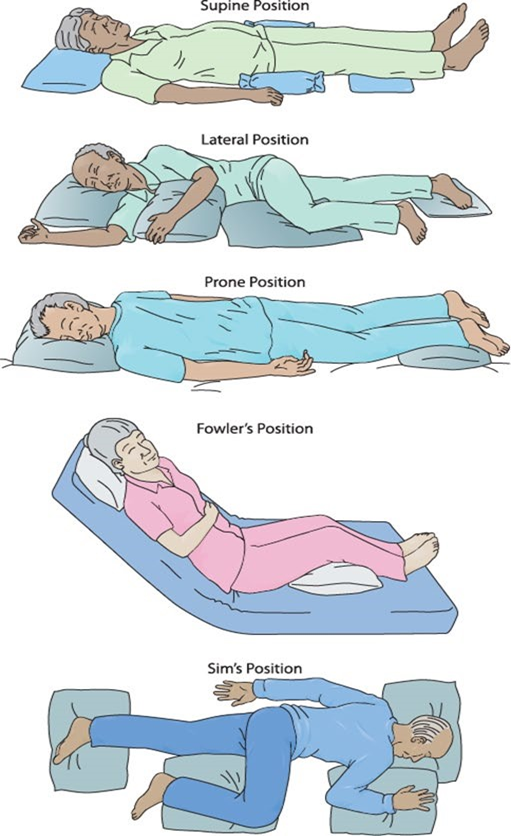
supine a body position in which a person lies flat on his back.
8. Explain the guidelines for safely positioning and moving residents
lateral body position in which a person is lying on either side
prone a body position in which a person is lying on his stomach or front side of the body.
8. Explain the guidelines for safely positioning and moving residents
Fowler’s a semi-sitting body position in which a person’s head and shoulders are elevated 45 to 60 degrees.
Sims’ a body position in which a person is lying on his left side with the upper knee flexed and raised toward the chest.
8. Explain the guidelines for safely positioning and moving residents
logrolling moving a person as a unit, without disturbing the alignment of the body.
dangle to sit up with the legs hanging over the side of the bed in order to regain balance and stabilize blood pressure.
8. Explain the guidelines for safely positioning and moving residents
NAs are often responsible for helping residents change positions and should remember these points:
- Changing position helps avoid muscle stiffness and skin breakdown.
- Bedbound residents should be repositioned at least every 2 hours.
Key Material 6-6: Five Basic Positions
8. Explain the guidelines for safely positioning and moving residents
8. Explain the guidelines for safely positioning and moving residents
What can an NA do to protect himself and residents from injury during positioning/moving?
8. Explain the guidelines for safely positioning and moving residents
ergonomics the science of designing equipment, areas, and work tasks to make them safer and to suit the worker’s abilities.
transfer belt a belt made of canvas or other heavy material that is used to help people who are weak, unsteady, or uncoordinated to transfer.
8. Explain the guidelines for safely positioning and moving residents
REMEMBER:
Many facilities have adopted no-lift, zero-lift, or lift-free policies. NAs must know their facility’s policies and follow them carefully.
8. Explain the guidelines for safely positioning and moving residents
True or False?
Ergonomics is the way the parts of the body work together when a person moves.
How does a transfer belt improve safety for residents and for nursing assistants?
Have you ever used or helped someone use a wheelchair before?
What are some guidelines for use of wheelchairs?
8. Explain the guidelines for safely positioning and moving residents
REMEMBER:
Before transferring a resident to a wheelchair, be sure the wheels are locked.
8. Explain the guidelines for safely positioning and moving residents
NA Denise is helping Mr. Cameron to the bathroom when he stumbles and starts to fall.
What should Denise do?
Key Material 6-7: Assisting a falling resident
- Widen your stance.
- Bring the resident’s body close to you.
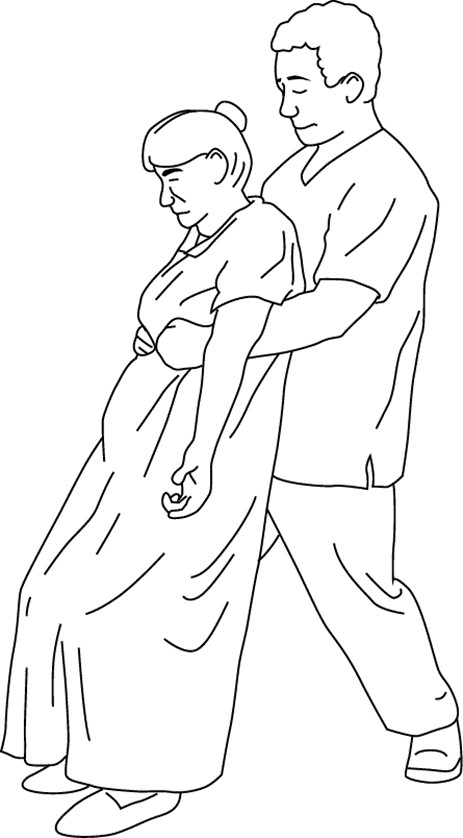
- Bend knees and support the resident.
- Lower resident to floor.
- Do not try to stop the fall.
- Call for help.
- Do not attempt to get the resident up.
8. Explain the guidelines for safely positioning and moving residents
True or False?
At a facility with a zero-lift policy, mechanical
lifts may be used to transfer residents.